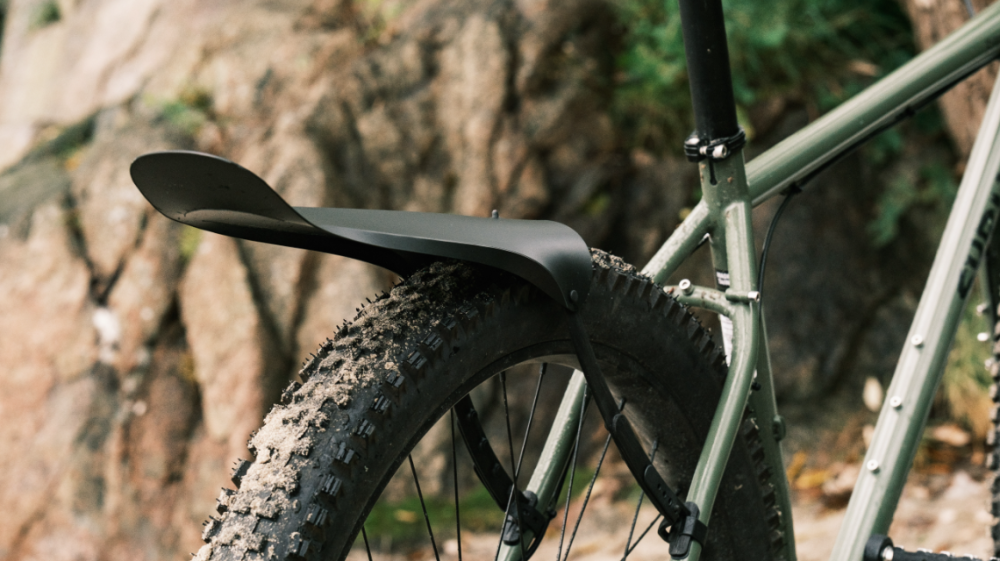
Just a few kilometres on a wet road – and there is already a stripe of mud up your back. The rain might have stopped an hour ago, but the road is still wet. Moments like these show why bike mudguards are one of the most practical cycling accessories.
Choosing the right mudguards, however, is not always straightforward. Some are long and cover most of the wheel, while others are so small you barely notice them. Some attach with bolts, while others can be fitted in seconds. Is knowing your wheel size enough? And what if your bike frame has no mounting points for mudguards?
Let's look at the most important things to consider so you can choose the right mudguards and avoid common mistakes.
Which mudguards are right for your bike?
The best place to start is with a simple question: where do you usually ride? On city streets, forest trails or gravel roads? The answer will help determine which type of mudguard is most practical for you.
- City bike. If you cycle to work, the shops or around town, long mudguards are worth considering. They cover more of the wheels and provide better protection against water and mud. Explore our city bike mudguards.
- Mountain bike (MTB). Compact mudguards designed for wider tyres are often a good choice for forest trails. They help reduce splashes but usually provide less protection than full-length models. Explore our MTB mudguards.
- Gravel bike. If you often ride on gravel tracks and wet tarmac, longer mudguards can be useful. If you only need them occasionally, quick-release models may be more convenient. Explore our gravel bike mudguards.
- Road bike. Weight matters, but so does the space between the tyre and frame. Not every mudguard fits a road bike, so always check compatibility before buying. Explore our road bike mudguards.
- Children's bike. Choose mudguards based on wheel size, tyre width and available mounting points. Explore our children's bike mudguards.
A simple tip: if your main goal is to arrive home with cleaner clothes, start by looking at longer mudguards. If you prefer a lightweight, barely noticeable accessory that reduces the worst splashes, a shorter model may be enough.
Is knowing your wheel size enough?
Imagine two bikes with 28-inch wheels. One is a road bike with narrow tyres, while the other is a city bike with much wider tyres. Although the wheel sizes are similar, the same mudguards may not fit both bikes.
That is why two things matter when choosing mudguards: wheel size and tyre width.
You can usually find the wheel size printed on the side of the tyre. It might be 26, 27.5, 28 or 29 inches. But this number alone is not enough.
For example, you might see 700 × 40C on your tyre. The number 40 means the tyre has a nominal width of approximately 40 mm. This measurement helps you find a mudguard designed for tyres of a suitable width.
Here is another useful detail: many 28-inch and 29-inch bikes use rims with the same 622 mm bead seat diameter. However, 29-inch MTB tyres are usually wider, so a mudguard that fits a city bike may not fit a mountain bike.
What should you do? Check the measurements printed on your tyre and compare them with the mudguard manufacturer's compatibility information before buying.
Why can mudguard width matter more than wheel size?
A mudguard must not only fit your wheel but also cover enough of the tyre. If it is too narrow, water and mud may spray out from the sides. If it is too wide or has the wrong shape, fitting it between the frame and tyre may be difficult.
A common mistake is assuming that any mudguard labelled for 28-inch wheels will fit. In reality, different bikes with 28-inch wheels can have very different tyre widths.
For example, if your tyres are 40 mm wide, look for a mudguard whose manufacturer specifically lists compatibility with tyres of that width. Do not automatically assume that every 45 mm mudguard will fit – the shape and mounting design also matter.
It is equally important to leave the clearance recommended by the manufacturer between the tyre and mudguard. This is especially important on gravel roads and forest trails, where mud can build up.
If you are unsure, check the tyre size, mudguard specifications and available space around the frame and fork. This is more reliable than choosing from a product photo alone.
Long or short mudguards – which should you choose?
There is no single right answer. It all depends on how much protection you need and the conditions you usually ride in.
Long mudguards cover a larger part of the wheel. They are especially practical for commuting or city cycling, when you would rather not clean mud off your trousers and jacket after every puddle.
Short mudguards are lighter and less noticeable. Some can be fitted and removed quickly, making them convenient if you only need splash protection occasionally.
There is one important difference: a small mudguard may stop some of the water and mud heading towards your face or back, but it usually offers less protection than a longer model.
If you mostly ride in dry weather and only occasionally encounter wet roads, a compact mudguard may be sufficient. But if your bike is your everyday transport, longer mudguards are usually the more practical choice.
Front, rear or a complete mudguard set?
After a ride on a wet road, your back may be covered in mud while your legs are relatively clean. Another time, water from the front wheel may splash onto your shoes and trousers. That is because front and rear mudguards serve different purposes.
- Front mudguard helps reduce splashes from the front wheel that can reach your legs, face or the front of the bike.
- Rear mudguard mainly protects your back and seat area from water and mud thrown up by the rear wheel.
- Mudguard set includes both front and rear mudguards and is a convenient choice if you want protection from both wheels.
If your main problem is a muddy back, a rear mudguard may be enough. But if you regularly ride on wet roads, having both is usually worthwhile.
What if your bike has no mudguard mounting points?
Do you have a road or gravel bike and cannot see anywhere to bolt on a mudguard? That does not mean you have to put up with a muddy back.
Some models do not require dedicated mounting holes. They can attach using straps around the fork or frame, underneath the saddle or with other specially designed mounts.
For example, some compact Ass Savers mudguards attach beneath the saddle, making them convenient when you only need splash protection from time to time.
However, the word "universal" does not guarantee that a mudguard will fit every bike. Always check the manufacturer's mounting requirements, and use only approved attachment methods on carbon components.
Explore our universal and Ass Savers mudguards.
Three mistakes that can leave you with the wrong mudguards
- Choosing by wheel size alone. Even if a mudguard is designed for 28-inch wheels, it may be too narrow for your tyres. Always check tyre width as well.
- Not checking the mounting points. Some mudguards require dedicated frame mounts, while others need specific brackets. Before buying, make sure you can fit the chosen model to your bike.
- Underestimating the protection you need. A short mudguard can be very convenient, but a longer one generally keeps your clothes cleaner if you cycle in rainy weather every day.
One more useful tip: check what is included in the box. Some mudguards require additional mounting parts, which you can find in our mudguard accessories category.
Frequently asked questions about bike mudguards
Will 28-inch mudguards fit a 29-inch bike?
Sometimes, but wheel size alone is not enough to determine compatibility. Although both types of bike often use rims with a 622 mm bead seat diameter, 29-inch MTB tyres are generally wider. Always check the manufacturer's compatibility information.
Can I install mudguards myself?
Many models can be installed at home by following the manufacturer's instructions. Some attach with straps, while others require bolts or special brackets.
Do electric bikes need special mudguards?
Not necessarily. Regular mudguards may also fit if they are compatible with the wheel size, tyre width, frame design and other bike components.
Are mudguards only useful when it rains?
No. They are also useful after the rain has stopped, when there is still water and mud on tarmac, gravel roads or forest trails.
How to choose the right mudguards without making a mistake
Before buying, ask yourself three questions: what type of bike do you ride, what size are its wheels and tyres, and how will the mudguards be mounted?
If you cycle around town every day, longer mudguards are usually worth considering. If you enjoy MTB or gravel routes, compatibility with wider tyres and enough room for mud are particularly important. And if you only need protection occasionally, quick-release models may be the most convenient solution.
Above all, do not choose based on a photo or wheel size alone. The right mudguards should fit your bike and provide the level of protection you actually need.
Explore all bike mudguards at Velonova. If you are unsure about compatibility, our specialists can help you choose the right model.

 Gifts
 Discounts