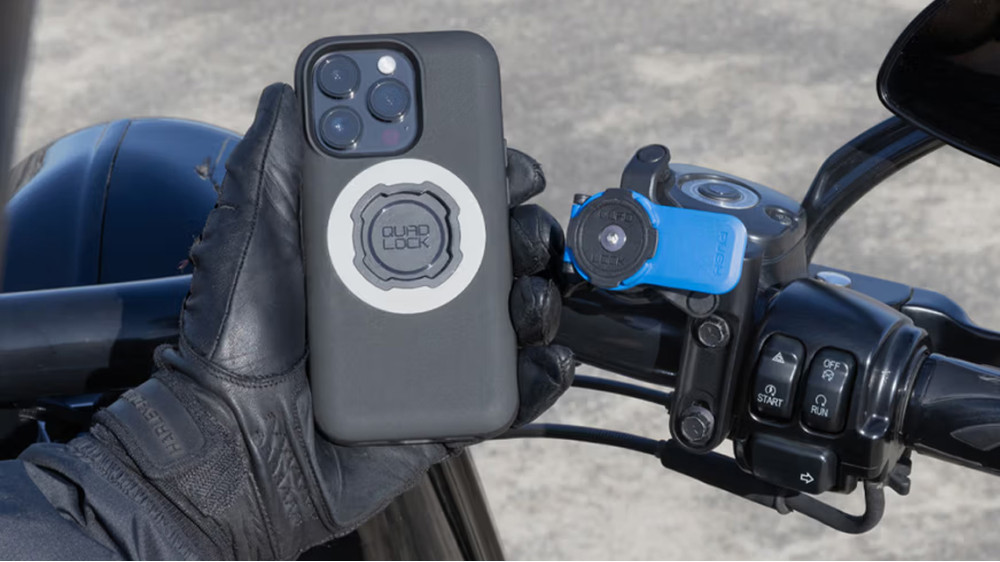
Planning a motorcycle trip and want to use your phone for navigation? It's important to consider not only where to mount your phone, but also how securely it will stay in place while riding. The wrong mount can interfere with your controls, while motorcycle vibrations may damage your phone's camera.
Which phone mount is right for your motorcycle? How do different mounting options compare, and when do you need a vibration dampener? Let's look at the key things to consider so you can choose the right mount and avoid common mistakes.
Which phone mount is right for your motorcycle?
When choosing a motorcycle phone mount, the design of your bike matters more than the appearance of the mount. A mount that works perfectly on a touring motorcycle may not be suitable for a sports bike.
- Motorcycles with tubular handlebars. A handlebar mount is often the most convenient option. It can be fitted to a suitable clear section of the handlebar, provided you check the handlebar diameter first.
- Sports bikes with clip-on handlebars. If the upper triple clamp has a suitable hollow steering stem, a Fork Stem Mount may be a good choice. It allows you to position your phone closer to the centre of the motorcycle.
- Motorcycles with limited handlebar space. A Handlebar Clamp Bolt Mount may be an option, attaching at a suitable handlebar clamp bolt position. Check the bolt dimensions and compatibility before purchasing.
- Scooters. When the handlebars are covered by plastic panels, a Mirror Mount may offer a practical solution. Make sure the mirror design and mounting dimensions are compatible.
Before choosing a mount, sit on your motorcycle in your normal riding position and consider where the phone screen would be easiest to see. It should not obstruct the instrument panel, interfere with the controls or prevent the handlebars from turning fully.
If you're unsure about compatibility, check the mount's installation dimensions and the manufacturer's fitting requirements.
Explore our range of motorcycle phone mounts to find a mounting option that suits your bike.
Can motorcycle vibrations really damage your phone's camera?
Yes, and this isn't just a concern discussed on motorcycle forums. Apple officially warns that strong vibrations at certain frequencies, particularly those generated by high-powered motorcycle engines, can affect the performance of iPhone cameras.
The reason lies inside the camera itself. Many modern smartphones use optical image stabilisation (OIS) to compensate for hand movements when taking photos. This system relies on tiny moving components inside the camera. Prolonged exposure to strong vibrations can affect their operation, potentially resulting in blurry photos or focusing problems.
What's interesting is that the phone may appear completely undamaged. The screen works and the casing looks fine, yet problems become noticeable when taking pictures.
The Quad Lock Vibration Dampener is designed to help reduce this risk. It fits between the mount and the phone mounting head. According to the manufacturer, it reduces more than 90% of high-frequency vibrations. However, this does not guarantee complete protection against camera damage.
Do you only need a vibration dampener on a powerful motorcycle? Not necessarily. Even smaller-capacity motorcycles can produce vibrations that may damage a phone camera. That's why Quad Lock recommends using a vibration dampener with all its motorcycle mounts. However, a dampener does not eliminate the risk entirely. For example, Apple advises against mounting an iPhone on high-powered motorcycles, even when vibration-dampening accessories are used.
Why isn't a magnetic car phone mount necessarily suitable for a motorcycle?
Magnetic phone mounts are convenient in cars: simply place your phone against the mount and the magnets hold it in position. On a motorcycle, however, your phone is exposed to different conditions, including vibration, wind resistance, uneven roads and sudden movements.
That's why Quad Lock motorcycle mounts use a mechanical locking system. The phone is placed onto the mount and twisted to lock it into position. To remove it, you need to release the locking mechanism.
Quad Lock MAG cases can sometimes cause confusion. Despite the MAG name, these cases also support the mechanical locking system. This means you can use the same compatible case with magnetic accessories in your car and a mechanical mount on your motorcycle.
The key difference: for motorcycle use, choose a purpose-designed mechanical locking mount rather than relying on a magnetic head alone.
Before buying a mount, check that you have a compatible phone case or an adapter suitable for your chosen mounting system.
Rain, sunshine and an overheating phone – what should you consider?
Even a securely mounted phone faces two additional challenges on a motorcycle trip: weather conditions and temperature.
Rain. Many modern smartphones have a water-resistance rating, but that doesn't mean they can be used indefinitely in all rainy conditions. Water spray, prolonged exposure to moisture and the condition of the charging port can all affect the phone. A compatible protective cover may help, but always check the manufacturer's stated level of protection.
Heat. On a sunny day, running navigation, using a bright screen and charging the phone can all contribute to overheating. If your phone displays a temperature warning, stop using it and allow it to cool according to the manufacturer's instructions.
Another practical consideration is screen visibility. Sunlight reflecting off a poorly positioned screen can make navigation difficult to follow. That's why an adjustable mounting position can sometimes be more valuable than extra features.
Is it worth charging your phone while riding?
For a short ride, your phone's battery may last without additional charging. On longer journeys, however, when navigation is running for several hours, charging can be particularly useful.
Quad Lock offers motorcycle-specific charging solutions, including wired and wireless charging accessories. It's important to choose equipment designed for motorcycle use, as not every wireless charging head intended for cars is suitable for mounting on a motorcycle.
Before purchasing, check that the charging accessory is compatible with your mount, phone and case, and confirm its power connection requirements. If you're unsure about connecting it to your motorcycle's electrical system, it's best to have it installed by a professional.
Three mistakes to avoid before your first ride
- Buying a mount without checking your motorcycle's design. An incompatible handlebar diameter or mounting opening may prevent installation. Always check the manufacturer's specified dimensions before buying.
- Overlooking the effect of vibration on the camera. A secure mechanical lock helps keep your phone attached, but it does not automatically protect the camera from harmful vibrations. These are two different functions.
- Adjusting navigation while riding. Even a clearly visible screen can be distracting. Set your route before setting off, and if you need to make changes, stop somewhere safe.
When choosing a motorcycle phone mount, start by identifying a suitable mounting position. Then check compatibility with your phone case and consider whether vibration dampening is needed. If you regularly use navigation on longer rides, it's also worth considering a charging option.
A good phone mount does more than simply hold your phone securely. It should fit your motorcycle, work with your phone case and make navigation convenient without compromising safe riding.

 Gifts
 Discounts