
 Gifts
Gifts Discounts

If you're just starting to ride a bike, you probably haven't thought about how often you'll need a bike pump. Many beginner cyclists only remember this accessory when a flat tire ruins their ride. To make inflating tires easier, this article will cover the main types of bike pumps, the advantages of each type, and help you choose which bike pump from velonova.lt suits you best.
Bicycle pumps: what to consider when choosing?
2025-07-10
 Vytautas Kaupas
Vytautas Kaupas
Main types of bike pumps
The right pump for you depends on the situation—whether you're inflating tires at home or topping up air during a ride. The more time you spend cycling, the more different types of pumps you'll likely try.
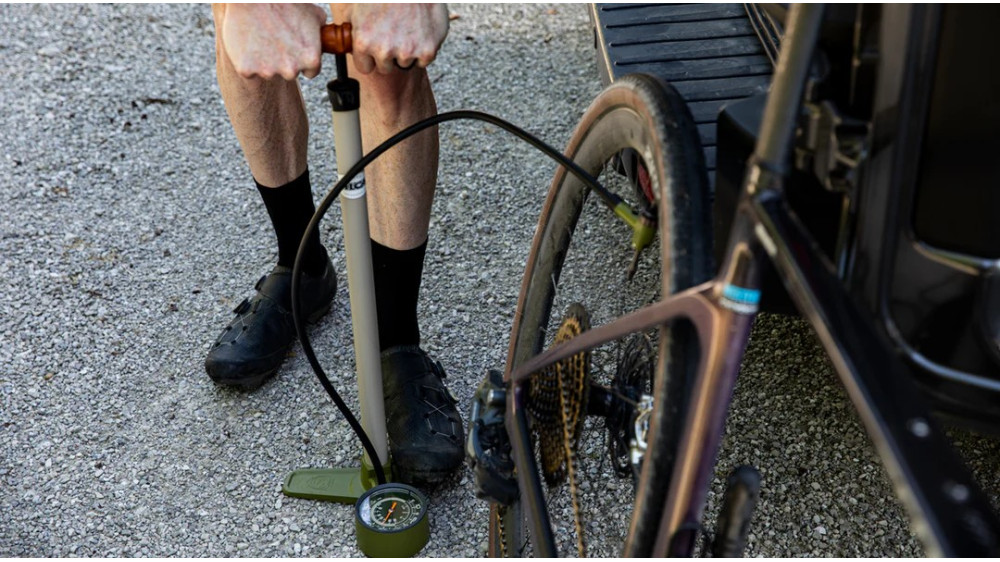
Floor pumps: a must-have at home or in the garage
You'll most likely inflate your tires with a floor pump—making it an essential tool for every cyclist at home. Floor pumps stand firmly on the ground, making them easy to use. Thanks to their high air volume, they inflate tires faster than handheld pumps and can reach up to 160 PSI or more. One of their greatest advantages is the built-in pressure gauge, ensuring you reach the correct pressure for your ride type. If you’re unsure about the brand, note that our customers most often choose Lezyne and Specialized floor pumps. You’ll find specific recommendations for different bike types below.
Mini (hand) pumps: your travel companion
A mini pump that fits in your jersey pocket or bag is your safety net on longer rides. Many models can also be mounted on the bike frame, so you never forget it. If you use a hand pump often, choose a compact yet powerful and durable model, like the Lezyne Pocket Drive Pro for all bikes or the Specialized Air Tool Big Bore for high-volume tires. Our customers also love SKS pumps, which include foot pumps too.
CO2 pumps: speed in racing
In races, even amateur ones, every second counts. That’s why cyclists using tubeless tires should learn how to use CO2 pumps. These pumps inflate a tire in seconds using compressed CO2 from a cartridge. Once activated via a valve adapter, pressure is instantly delivered, depending on cartridge size. Since cartridges cool rapidly, hold them using the neoprene sleeve provided or wear gloves. When choosing a CO2 pump, consider the cartridge capacity—CO2 cartridges are single-use, so large ones aren't always practical for non-MTB tires. Also, note how the pump attaches to the valve (push or screw) and choose what suits you best.
Electric pumps: a fast-growing innovation
Electric pumps are rapidly gaining popularity for their ease and consistency. They are a sustainable alternative to CO2 cartridges with additional benefits. These pumps deliver steady pressure without spikes, and only need to be charged—usually in under an hour. You can also take them on long trips, as they’re allowed in hand luggage.
Currently, Velonova offers two USB-C rechargeable electric mini pumps:
- SILCA Micro—equivalent to 3.5 CO2 cartridges per charge, compatible with Schrader (AV) and Presta (SV) valves.
- SILCA Ultimate—features a digital display and inflates up to 100 PSI with 1% accuracy, replacing up to 9 cartridges per charge.
Electric pumps are also produced by VOXOM. VOXOM bike pumps are innovative and very high quality.
How to choose a pump by bike type and riding style
Pumps for road bikes
Road bike tires usually require 80–120 PSI. Choose a high-pressure pump (7–10 bar) with a gauge. Our picks:
- Specialized Air Tool HP—reaches up to 180 PSI with 30% less effort.
- VOXOM PU15—sturdy steel build and soft handles, ideal for up to 160 PSI.
- Lezyne Micro Floor Drive Digital HPG—compact yet powerful pump for 160 PSI.
Pumps for gravel bikes
Gravel bike tires usually require 30–60 PSI. A mid-volume pump with an accurate gauge is essential for adjusting pressure depending on terrain. Recommended:
- Specialized Air Tool Comp—large chamber and precise gauge.
- Lezyne Gravel Digital Drive Pro—long hose for convenience in all conditions.
- Lezyne CNC Digital Drive 3.5—a stylish, powerful choice for pros.
Pumps for mountain and electric bikes
MTB tires are wide but need only 20–40 PSI. Use a high-volume pump to fill them quickly. We recommend:
- Lezyne Micro Floor Drive Digital HVG—accurate digital gauge for large-volume tires.
- Specialized Air Tool MTB—designed specifically for low-pressure, high-volume tires.
- Lezyne CNC Tubeless—includes a hand pump, CO2 cartridge, and tubeless repair tools.
Pumps for city, hybrid, and touring bikes
These bikes usually require moderate and not highly precise pressure. Choose a durable, budget-friendly pump that's easy to use. Our picks:
- BETO Y—very economical, inflates up to 160 PSI.
- VOXOM PU10—minimalist design.
- Specialized Air Tool Sport—powerful and user-friendly.
Other important factors to consider
- Digital pressure measurement: Digital gauges show pressure more accurately.
- Valve type compatibility: Ensure the pump works with Schrader, Presta, or Dunlop valves. Most modern pumps are compatible, but it’s always good to check.
- Pump body material: Aluminum is light and durable; plastic is lighter but may wear out faster.
- Bleed valve: Useful for fine-tuning tire pressure after inflating.
By considering these criteria, you’ll easily find the right pump for your bike in our online store. If you need more advice, visit the VELONOVA store in Vilnius, J. Baltrušaičio g. 1.